CAFNIA PRESS · 2026
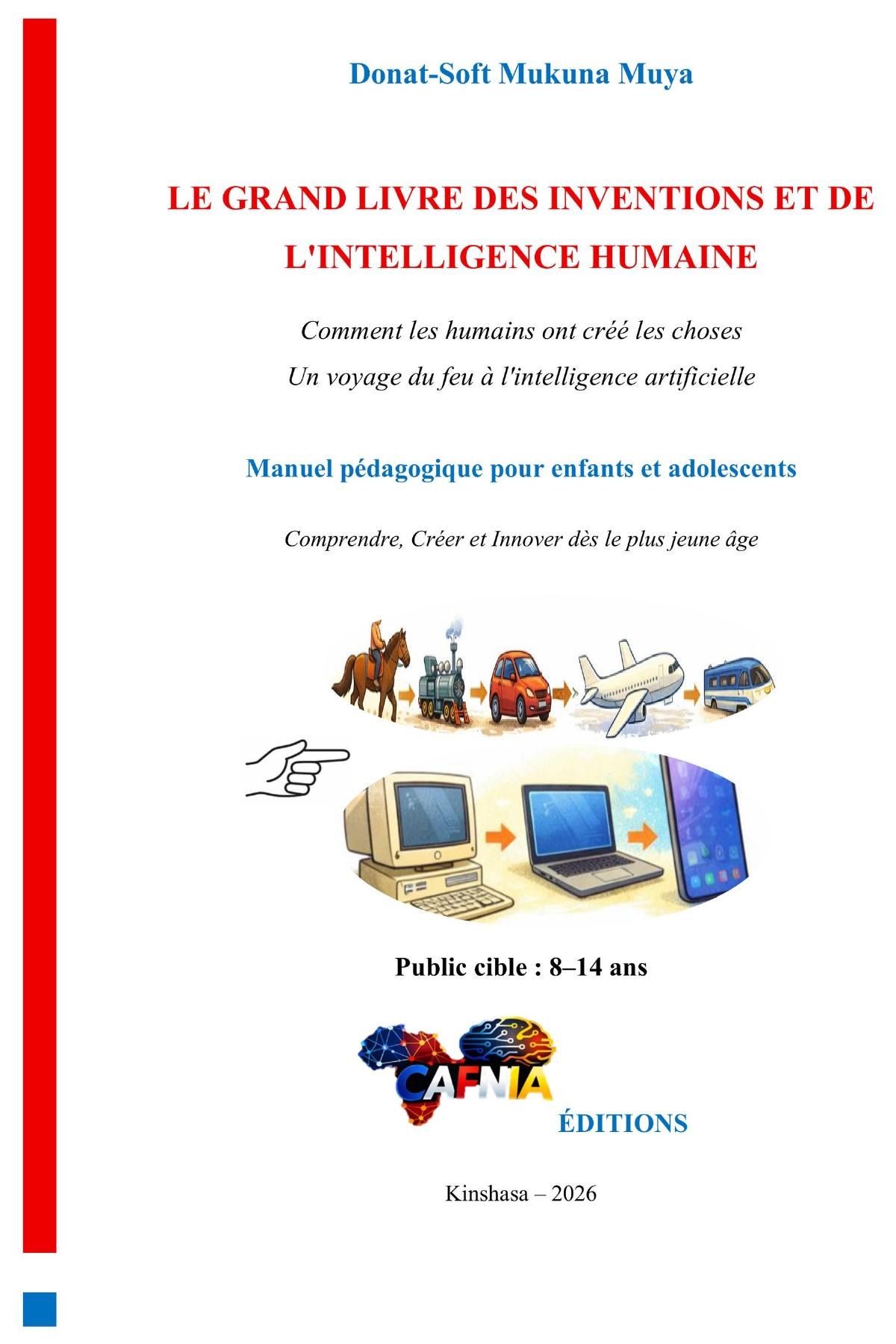
The Great Book of Inventions and Human Intelligence
Donat-Soft Mukuna Muya
This pedagogical manual traces the history of human innovation, from fire to artificial intelligence, through 30 chapters designed for children and adolescents aged 8 to 14 in the Democratic Republic of Congo. Organized into six parts, each chapter answers the question "How was this created?" and integrates practical exercises achievable with limited resources. Its aim is to demystify technology and show that innovation has neither nationality nor economic barriers.
Summary
By contextualizing inventions to the specific challenges of the DRC (electricity access, irrigation, resource management), the book encourages young Congolese to see themselves as potential creators of solutions adapted to their environment. It teaches the scientific method (observe, try, fail, correct, retry) as a transferable skill, values failure as a learning stage, collaboration as a multiplying force, and ethics as an indispensable safeguard of innovation. A final section offers riddles, construction challenges, logic puzzles and creative projects, with an answer key and assessment grids for parents and teachers. The grand final challenge invites each child to identify a real problem in their community and design an innovative solution.
Table of contents
- 01 EPIGRAPH
- 02 FOREWORD FOR PARENTS: How to make the most of this book
- 03 PREFACE: Educational guidance
- 04 LIST OF ABBREVIATIONS · TECHNICAL GLOSSARY · SUMMARY / ABSTRACT
- 05 PART I · HUMANITY'S FIRST INVENTIONS
- 06 1. Fire, the first great discovery
- 07 2. Stone tools
- 08 3. Agriculture and patience
- 09 4. Writing: speaking without being present
- 10 5. Numbers and mathematics
- 11 PART II · INVENTIONS THAT TRANSFORM SOCIETIES
- 12 6. The wheel
- 13 7. The printing press
- 14 8. Electricity
- 15 9. Industrial machines
- 16 10. Modern transport
- 17 PART III · THE DIGITAL WORLD
- 18 11. The computer
- 19 12. The Internet
- 20 13. The smartphone
- 21 14. Video games and virtual reality
- 22 15. Data
- 23 PART IV · ARTIFICIAL INTELLIGENCE AND ROBOTICS
- 24 16. What is artificial intelligence?
- 25 17. Robots
- 26 18. AI at school
- 27 19. AI in medicine
- 28 20. The dangers of AI
- 29 PART V · INVENTING THE FUTURE
- 30 21. Every child can invent
- 31 22. Green inventions
- 32 23. Smart cities
- 33 24. Space and the stars
- 34 25. The ethics of invention
- 35 PART VI · BECOMING THE INVENTOR OF YOUR OWN LIFE
- 36 26. Learning to ask questions
- 37 27. Failure is not an enemy
- 38 28. Working together
- 39 29. Imagining a better world
- 40 30. The future starts today
- 41 GENERAL CONCLUSION · BONUS ACTIVITIES · ANSWER KEY GUIDE · MESSAGE TO PARENTS AND TEACHERS · BIBLIOGRAPHY
Introduction
Dear parents and educators of the Democratic Republic of the Congo, If you are holding this book, it is because you believe in your child's future. That gesture alone is already an act of hope and responsibility. We live in a time of deep transformation. Technology is reshaping how we communicate, work, heal, learn and produce. Artificial intelligence, robotics and connected devices are no longer science fiction: they are already part of the world in which our children are growing up and will work. Yet in our country one idea still persists: that innovation belongs to other peoples. This book exists to dismantle that belief. Its purpose is not only to tell the history of inventions, but above all to change how our children see themselves, no longer as mere users of technologies from elsewhere, but as minds able to understand, imagine and create. Innovation has never had a nationality. Marie Curie came from an occupied country and studied clandestinely. Nikola Tesla was born in a remote village, without wealth or privilege, but with insatiable curiosity. Steve Jobs grew up in a modest family and started in a garage. Inventors are shaped not by their origins but by their way of thinking. Our children face challenges that call for local solutions. The DRC holds strategic resources essential to modern technology, yet stable electricity, drinking water and food security remain out of reach in many regions. These realities are not only problems: they are also opportunities for invention. Technological education begins with understanding. Before coding, before building machines, a child must understand how things work and why they exist. This book does not turn children into engineers: it develops a way of thinking that applies to technology as much as to agriculture, health, trade or governance. Curiosity is the engine of all innovation. Every chapter shows that an invention always begins with a simple question.
The rest of the book is reserved for readers who purchased the full edition.
Get the bookExcerpt (PDF)
Buy this book · from 20.00 USD
Pay by Mobile Money or bank transfer, then fill in the form. The book is emailed to you once the payment is confirmed.
Mobile Money
- M-Pesa / Orange / Airtel : +243 816 852 984
- Beneficiary : CAFNIA SARL
Bank transfer
- Equity BCDC : 711200321177546
- CAFNIA SARL · USD / CDF
- LANGUAGE
- FR
- PAGES
- 191
- ISBN
- 978-99951-775-3-3
A question about our books? edition@cafnia.org