
CAFNIA PRESS · 2026
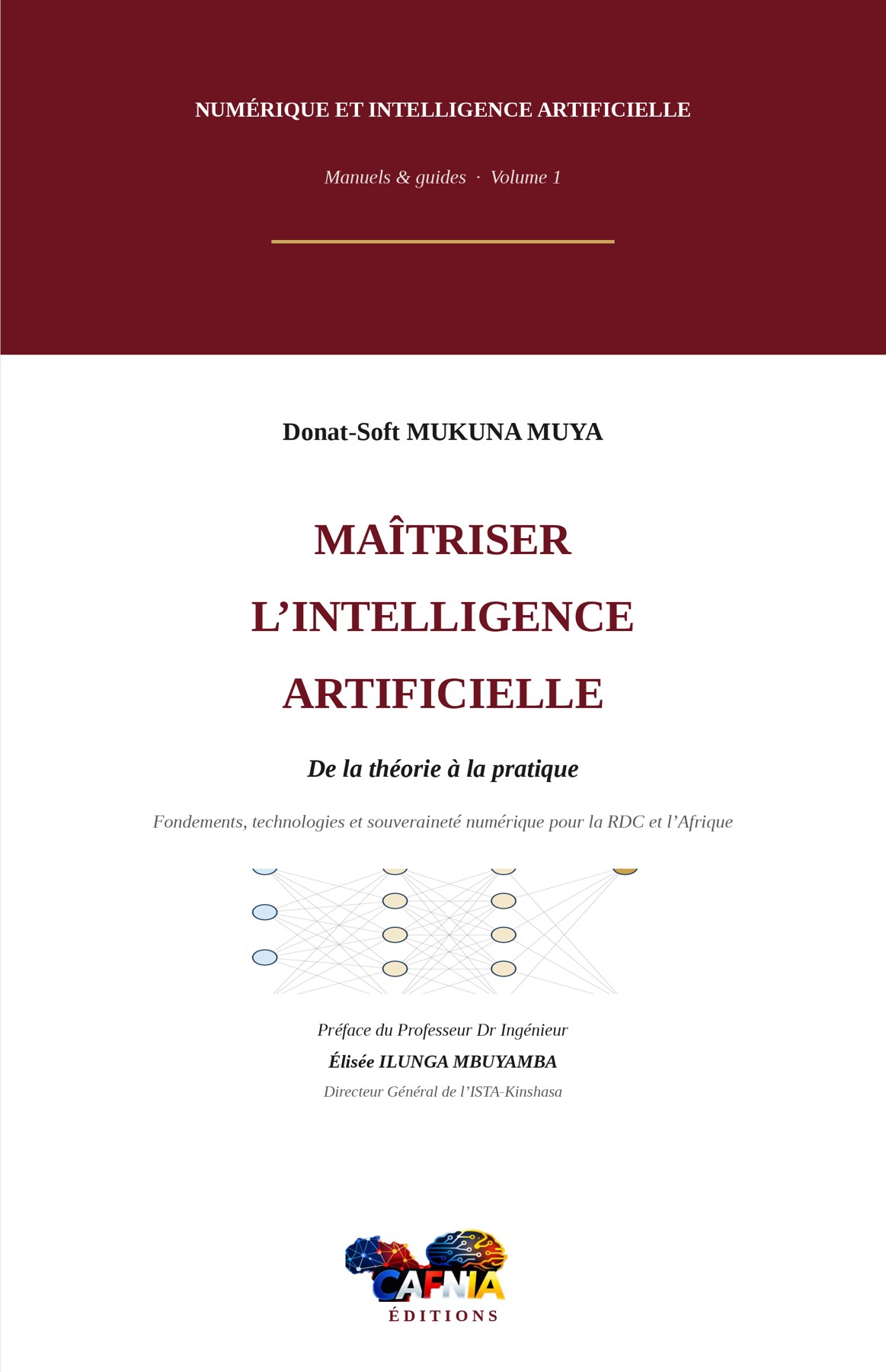
Mastering Artificial Intelligence: From Theory to Practice
Donat-Soft Mukuna Muya
Mastering Artificial Intelligence, From Theory to Practice is an academic textbook that guides the reader from the foundations of AI to its most advanced applications, firmly grounded in the realities of the Democratic Republic of the Congo and Africa. Structured in eight parts and thirty-five chapters, with hands-on workshops and reference appendices, the book first sets out the history, core concepts and main types of AI, then the technologies that underpin it: machine learning and deep learning, natural language processing and computer vision. It goes on to address generative AI, intelligent agents, prompt engineering and AI-assisted scientific research. Beyond the technical dimension, the textbook advances a central thesis: for Africa, artificial intelligence is not merely a tool for technological catch-up but a genuine matter of sovereignty, involving data, national languages, infrastructure (sovereign cloud, data centres) and public decision-making. Ethics, bias, cybersecurity, geopolitics, regulation and national strategy are treated as conditions for true mastery. Each chapter combines learning objectives, illustrated explanations, summary boxes, Congolese case studies and practical exercises, with the aim of training researchers, professionals and policymakers who can not only use AI, but govern it in the service of their nations. Keywords: artificial intelligence; machine learning; deep learning; generative AI; natural language processing; computer vision; prompt engineering; digital sovereignty; AI governance; ethics and algorithmic bias; cybersecurity; national strategy; Democratic Republic of the Congo; Africa.
Summary
Academic textbook: 35 chapters · 4 hands-on workshops · 6 appendices. Intended for higher education, professional training and public decision-making. First edition, 2026. Published by CAFNIA SARL (CAFNIA Éditions), Kinshasa. Preface: Prof. Dr Eng. Élisée Ilunga Mbuyamba, Director General of ISTA, Kinshasa. Author: Donat-Soft Mukuna Muya, ORCID 0009-0006-1911-3277. ISBN: 978-99951-775-5-3. Production authorisation no. 096/SG/MIN/CAP/LAT/DAL/MME/OMG/2026. Legal deposit: no. HG 3.02606-57391, National Library, Kinshasa, June 2026. Printed by SENAPI, Democratic Republic of the Congo. © 2026, Donat-Soft Mukuna Muya. All rights reserved.
Table of contents
- 01 Foreword
- 02 Preface: Prof. Dr Eng. Élisée Ilunga Mbuyamba, Director General of ISTA, Kinshasa
- 03 How to use this book
- 04 Abstract
- 05 General introduction: A civilisational revolution
- 06 Part I: Foundations of artificial intelligence (history, key concepts, types of AI)
- 07 Chapter 3: The different types of artificial intelligence
- 08 Part II: AI technologies (machine learning and deep learning, natural language processing, computer vision)
- 09 Part III: AI, security and sovereignty
- 10 Chapter 12: Artificial intelligence, security and defence
- 11 Part IV: Governance, ethics and regulation
- 12 Part V: Foresight
- 13 Chapter 18: The future of AI and superintelligence
- 14 Part VI: Generative AI, intelligent agents and prompt engineering
- 15 Chapter 24: Prompting basics
- 16 Chapter 25: Advanced prompting methods
- 17 Chapter 26: Professional prompting case studies
- 18 Part VII: AI-assisted scientific research
- 19 Chapter 27: AI-assisted research methodology
- 20 Chapter 28: The literature review
- 21 Chapter 29: AI-assisted academic writing
- 22 Chapter 30: Scientific ethics in the age of AI
- 23 Part VIII: Technical deep dives (reinforcement learning and alignment, deployment and MLOps, evaluation, hardware and energy cost) and a 2024-2026 regulatory overview
- 24 Bonus module: 4 hands-on workshops
- 25 Appendices: 6 reference appendices
Introduction
Artificial intelligence is no longer a distant promise confined to the laboratories of the great powers: it is now an everyday reality reshaping the way we learn, care, produce, govern and decide. Faced with such a shift, two attitudes would be equally perilous: naive fascination and fearful rejection. This book proposes a third path: mastery. Mastering artificial intelligence means first understanding it; its foundations, methods, promises and limits, without needless jargon yet without oversimplification. It then means using it with discernment, keeping in mind that no machine relieves human beings of the duty to think, to verify and to own their choices. Finally, and perhaps above all, it means placing it at the service of priorities that are our own. For the decisive question, for the Democratic Republic of the Congo and for Africa, is not whether AI will arrive, it is already here, but whether we will endure it or turn it into a lever of development, sovereignty and dignity.
The rest of the book is reserved for readers who purchased the full edition.
Get the bookExcerpt (PDF)
Buy this book · from 20.00 USD
Pay by Mobile Money or bank transfer, then fill in the form. The book is emailed to you once the payment is confirmed.
Mobile Money
- M-Pesa / Orange / Airtel : +243 816 852 984
- Beneficiary : CAFNIA SARL
Bank transfer
- Equity BCDC : 711200321177546
- CAFNIA SARL · USD / CDF
- LANGUAGE
- FR
- ISBN
- 978-99951-775-5-3
A question about our books? edition@cafnia.org