Two volumes, one commitment to accountability
Published by CAFNIA ÉDITIONS in its “Gouvernance publique” collection, the practical treatise connects procurement law with the daily decisions of those who prepare, award and oversee public contracts. Volume I, Fondements, institutions et méthodes de passation, has a foreword by Professor Daniel MUKOKO SAMBA, its patron. Volume II, Dossiers types, processus de passation, prestations intellectuelles, contrat et exécution, has a foreword by Professor Évariste MABI MULUMBA, its patron.
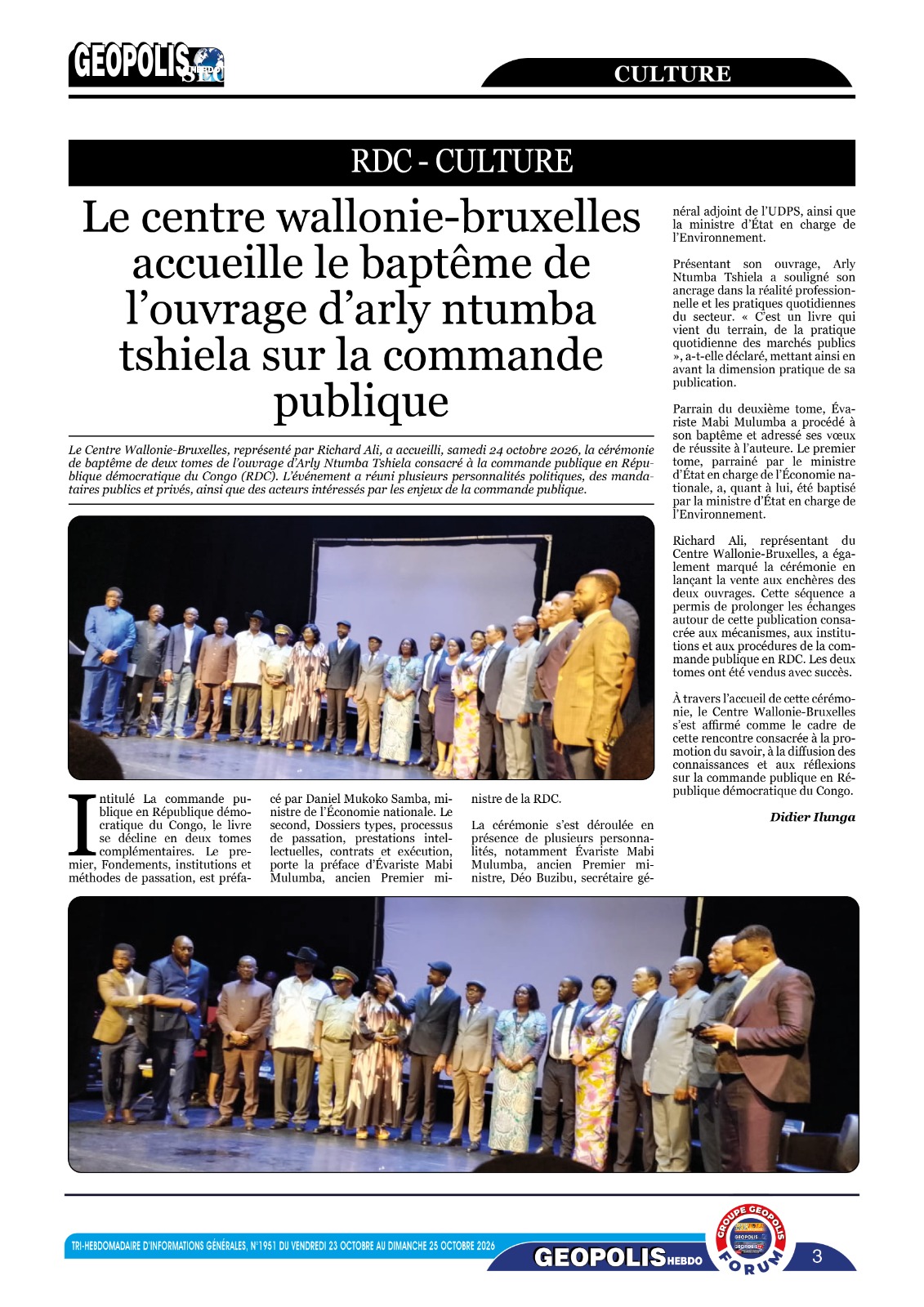
The ceremony report notably records the presence of Professor Évariste MABI MULUMBA, Minister Marie NYANGE NDAMBO and writer Richard ALI. The supplied contributions explain the gathering’s central concern: how a legal rule becomes a decision, then delivered goods, an effective service or a completed infrastructure project.
Open, rigorous and accessible African scholarship
Speaking for CAFNIA ÉDITIONS, Professor Jean-Marie BEYA KAMBA frames the publication within a clear editorial ambition: disseminating rigorous and useful African scholarship. His text identifies three reasons for selecting the manuscript: the importance of its subject, its approach following the actual procurement process, and the care taken in checking references.
The books open the “Gouvernance publique” collection directed by Professor Cyprien MULUMBA TSHIENDA. They reflect publishing as a process of organising knowledge, examining its foundations and making it usable. Both the publisher’s and the author’s texts also acknowledge the technical contribution of Dr Donat-Soft MUKUNA MUYA.
Volume I: understanding the rules before deciding
Professor Cyprien MULUMBA TSHIENDA’s presentation highlights the first volume’s distinctive method: rather than simply commenting on each legal provision, it follows the procurement chain. From identifying a need to planning, preparing documents and choosing an award procedure, readers encounter the institutions, responsibilities and safeguards relevant to each stage.
Its thirty-four chapters are supplemented by sixty practitioners’ questions, corrected practical exercises and reference annexes. It distinguishes applicable law from the reform under preparation and includes a concordance grid to help readers track legislative changes. The purpose is practical: identifying the relevant rule, avoiding an error and keeping the evidence needed to justify a decision.
Volume II: documenting decisions and overseeing delivery
The presentation text entrusted to Madame Sylvie ELENGE NYEMBO, Director-General of RTNC and a teaching staff member at UNISIC, introduces a complementary question: what documents must be produced? The law becomes effective when decisions can be evidenced and a contract leads to a verifiable outcome.
The fifty-four chapters cover standard tender documents, bid evaluation, consultancy services, contracts, technical and financial monitoring, acceptance, guarantees and disputes. Tables, exercises and ten ready-to-use templates make the volume a working companion. Minutes, verification sheets and acceptance records are not merely formalities: they are evidence.
Practitioners and engineers: the reality behind the file
The written testimony of Alain MUKUNA MWEMBI, a director at the Office des Routes responsible for procurement management, returns to everyday questions: choosing the correct procedure, preparing a document at the right time, justifying a payment and protecting a file against challenge. He values a book organised in the order in which difficulties arise.
Professor Raphaël MATAMBA JIBIKILA, a doctor of engineering sciences and mining engineer, adds a technical perspective. His text stresses that procedural compliance cannot compensate for an ill-defined need or imprecise specifications. In infrastructure and strategic sectors, sound specifications, supervision and acceptance determine the outcome. He also emphasises passing knowledge on to younger engineers, lawyers and economists.
The forewords: from budget approval to completed work
The foreword extracts assembled for moderator Professor Joséphine NTUMBA KANKOLONGO illuminate the economic significance of the books. Professor Daniel MUKOKO SAMBA explains how the procurement chain determines the real return on public spending. Professor Évariste MABI MULUMBA focuses on losses arising from inadequately monitored execution.
Their perspectives converge: a sound budget and a signed contract are not enough. Between authorising expenditure and obtaining the expected result, every stage requires vigilance, reliable documentation and clear accountability.
Arly NTUMBA TSHIELA: a book born of professional practice
In her address, the author traces the project to daily work in a public procurement management unit, followed by three years of research, writing and verification. Colleagues’ questions shaped the structure. Her aim was to turn professional experience into accessible answers and practical tools, not to add an abstract legal commentary.
Madame Arly NTUMBA TSHIELA advocates a constructive approach rather than an indictment of institutions: understand the rules, observe practice, document decisions and train teams. She thanks the foreword authors, the collection director, CAFNIA ÉDITIONS, Dr Donat-Soft MUKUNA MUYA and her family. She invites readers to use, discuss and, where necessary, challenge the books with documented observations.
Beyond the launch: putting knowledge to work
The value of the gathering lies in the convergence of perspectives: the publisher emphasises scholarly rigour, the collection director method, practitioners documentation, the engineer delivery and the author responsibility. Together, they invite readers to assess procurement by what it actually brings to the population.
For CAFNIA, the launch is both a step in disseminating knowledge and the start of a dialogue with administrations, businesses, researchers and students. Its most meaningful continuation is the one the author seeks: books open on working desks, documented feedback and steadily improving practice.